Hurufo Numero: Bridging Typography and Data in the Modern Design Landscape
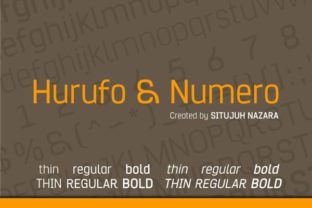
In an era where information moves at unprecedented speed and visual communication often determines what captures attention, the role of typefaces has expanded far beyond mere legibility. Among the emerging typographic innovations, Hurufo Numero stands out as a distinctive approach that reimagines how alphabetic and numeric characters coexist within a unified visual system. This typeface family does not simply render letters and numbers side by side; it integrates them with a coherence that speaks directly to contemporary needs in branding, data visualization, user interfaces, and editorial design.
For designers, content creators, and business owners alike, understanding what makes Hurufo Numero different is less about admiring a stylistic novelty and more about recognizing a practical tool that addresses a recurring friction: the awkward visual mismatch between text and numerals. Anyone who has worked with spreadsheets, financial reports, dashboards, or mixed-content layouts has encountered this subtle but persistent problem. Hurufo Numero offers a response that is both elegant and functional.
Why the Relationship Between Letters and Numbers Matters More Than You Think
Typography, at its core, is about establishing harmony. When a typeface treats letters and numbers as design siblings rather than distant cousins, the reading experience improves measurably. Traditionally, many typefaces have approached numerals as an afterthought — something added to complete the character set rather than something engineered with the same care as the alphabet. The result is often a visual disconnect: numbers that feel too wide, too narrow, too tall, or simply out of step with the surrounding text.
Hurufo Numero challenges this convention by treating every glyph — whether alphabetic or numeric — as part of a single, intentional design vocabulary. The stroke weights, the curvature, the proportions, and even the rhythm of spacing are calibrated so that when a reader encounters a sequence like "Q2 revenue increased 34%," the transition from letters to numbers is seamless. This may sound like a small detail, but in practice, it reduces cognitive friction and allows the reader to focus on meaning rather than on decoding visual inconsistencies.
For professionals who produce annual reports, investor presentations, or data-rich publications, this consistency translates directly into credibility. A document where numbers look like they belong with the text signals care and professionalism. Conversely, even a well-researched report can feel amateurish if the typography betrays a lack of attention to detail.
Core Characteristics of Hurufo Numero
To appreciate what Hurufo Numero brings to the table, it helps to examine its defining attributes in more detail. These characteristics are not arbitrary stylistic choices; they emerge from a deliberate design philosophy aimed at solving real-world communication challenges.
Proportional Consistency Across Alphabetic and Numeric Characters
One of the most immediately noticeable features of Hurufo Numero is how naturally its numerals sit alongside lowercase and uppercase letters. The x-height of the numerals is carefully matched to the x-height of the lowercase alphabet, preventing the common problem where numbers appear either too tall or too short in mixed text. This is especially critical in body copy, financial tables, and any context where numbers appear within sentences.
In many conventional typefaces, numerals are designed with a height that matches capital letters, which can cause them to feel oversized when used with lowercase text. Hurufo Numero avoids this by using a proportional approach that prioritizes visual flow over rigid adherence to traditional metrics. The result is a typeface that feels modern and approachable rather than formal or mechanical.
Tabular and Proportional Figures Built into the Design
Data-heavy documents demand flexibility. Hurufo Numero includes both tabular and proportional numeral variants as part of its standard character set. Tabular figures, where each digit occupies the same width, are essential for aligning columns in tables, financial statements, and statistical reports. Proportional figures, where each digit has a natural width relative to its shape, are better suited for running text where visual evenness matters more than column alignment.
Having both options available without switching typefaces streamlines workflow for designers and ensures consistency across different sections of a document. A business report might use tabular figures in its financial appendix while using proportional figures in its executive summary, all within the same typographic voice.
Legibility at Multiple Sizes and Resolutions
Whether rendered in print at six points or displayed on a high-resolution screen at sixty pixels, Hurufo Numero maintains clarity. The counters — the enclosed spaces inside characters like '8' or 'e' — are generous enough to prevent filling in at small sizes, while the stems and terminals are robust without feeling heavy. This makes the typeface suitable for applications ranging from mobile app interfaces to large-format signage.
For developers and product designers, this multi-resolution performance reduces the need for separate typeface choices across different breakpoints. A single typeface that works well in both a 14-point button label and a 48-point headline simplifies design systems and improves visual consistency across digital products.
Real-World Applications Across Industries
The versatility of Hurufo Numero makes it relevant to a wide spectrum of users. Rather than being confined to a single niche, it finds utility in contexts as varied as corporate branding, educational materials, scientific publishing, and interactive dashboards.
Financial Services and Corporate Communication
Banks, investment firms, and insurance companies produce vast quantities of documents where numbers are not just present but central. Quarterly reports, portfolio statements, risk assessments, and compliance documents all depend on clear, trustworthy typography. Hurufo Numero's ability to present numeric data with the same visual refinement as textual content helps these organizations project precision and reliability.
In a competitive industry where every detail contributes to client confidence, a typeface that makes numbers look intentional rather than incidental is a strategic asset. The unified visual language reduces the mental effort required to process mixed-content information, which can be especially valuable in time-sensitive contexts like market updates or client presentations.
Data Journalism and Information Design
News organizations and data visualization teams often work with complex datasets that must be communicated quickly and clearly to a general audience. Hurufo Numero supports this mission by providing a typographic foundation that integrates charts, infographics, and explanatory text into a cohesive visual narrative.
When a chart label uses the same typeface as the accompanying article, the reader moves effortlessly between data and interpretation. This continuity is not merely aesthetic; it supports comprehension by reducing the visual boundaries between different types of information. For journalists and editors, this means that the typographic choices in a graphics package no longer need to be a separate consideration from the text typeface.
Educational Publishing and Instructional Design
Textbooks, workbooks, and online learning platforms present a unique challenge: they must blend explanatory text, mathematical expressions, scientific notation, and assessment questions in a way that feels natural rather than disjointed. Hurufo Numero's consistent treatment of letters and numbers helps students focus on content rather than on deciphering inconsistent glyph shapes.
In mathematics and science materials, where numbers and symbols are dense, the clarity of each character directly affects usability. A typeface that distinguishes clearly between '1', 'l', and 'I' — or between '0' and 'O' — is not a luxury; it is a prerequisite for accurate reading. Hurufo Numero addresses these common confusions through deliberate differentiation of similar-looking glyphs, reducing the likelihood of misinterpretation.
User Interface and Product Design
Digital products — from productivity apps to e-commerce platforms — rely on typography to guide users and convey information efficiently. Buttons, form fields, pricing tables, progress indicators, and notification badges all mix letters and numbers in ways that affect user experience. Hurufo Numero's clean proportions and consistent weight distribution make it a strong candidate for UI design systems where clarity and consistency are paramount.
For product teams, adopting a typeface that handles numbers as gracefully as letters means fewer edge cases to manage. The pricing line "$49.99/month" reads with the same rhythm as the product name "Premium Plan." The notification "3 new messages" does not visually stutter between the digit and the word. These micro-interactions accumulate into a user experience that feels polished and intentional.
Practical Considerations for Adoption
While Hurufo Numero offers compelling advantages, integrating any new typeface into an existing workflow requires thoughtful planning. Here are some considerations for teams and individuals evaluating its potential.
Licensing and Availability
Before committing to a typeface for a project or organization, understanding the licensing terms is essential. Hurufo Numero is available under various licensing models depending on the foundry or distributor. Some licenses cover desktop use for print and static digital images, while web and app licenses are typically separate. For organizations with multiple designers or large-scale digital products, a comprehensive license that covers all intended use cases is more cost-effective than piecemeal purchasing.
Integration with Existing Design Systems
If your organization already uses a specific typeface family for branding or product design, introducing Hurufo Numero may require careful consideration of how it complements or contrasts with existing typography. In some cases, it may serve as a specialized secondary typeface for data-heavy contexts while the primary brand typeface handles headlines and body text. In other cases, it might become the primary workhorse for all mixed-content communication.
The key is to evaluate whether the visual voice of Hurufo Numero aligns with the brand's personality. Its modern, clean aesthetic tends to suit brands that value clarity, precision, and approachability. For brands with a more ornate or traditional identity, the transition might require testing with representative content to ensure coherence.
Technical Implementation in Digital Environments
For web and app use, proper implementation of Hurufo Numero involves not just loading the font files but also configuring OpenType features to activate the desired numeral styles. Tabular figures, proportional figures, and other stylistic alternates are accessed through CSS or platform-specific typography APIs. Testing across browsers and devices is recommended to ensure consistent rendering, especially for fractional widths and positioning.
Developers should also consider performance implications. While Hurufo Numero is well-optimized, using a full typeface family with multiple weights and styles can impact page load times if not managed carefully. Subsetting the font to include only the characters needed for a given language or use case can reduce file size significantly without sacrificing functionality.
Observations from Practitioners
Designers who have worked with Hurufo Numero in production environments often note that its impact is most apparent in the details that users may not consciously notice but that collectively shape their experience. A financial analyst preparing a client report might not articulate why the document feels more polished than previous versions, but the seamless integration of numbers and text contributes to that impression. A UI designer might observe that form fields with numeric input feel less cluttered because the characters align naturally with adjacent labels.
In educational settings, teachers have reported that students reading materials set in Hurufo Numero seem to make fewer misreadings of numeric data, especially in contexts where similar-looking characters could cause confusion. While anecdotal, these observations align with what typographic research suggests about the relationship between glyph design and reading accuracy.
Looking Ahead: The Evolving Role of Numeric Typography
As data becomes increasingly central to everyday life — from personal finance tracking to health monitoring to civic information — the typography that presents this data will continue to gain importance. Hurufo Numero represents a thoughtful response to a need that has long been underserved. Its design philosophy, which treats letters and numbers as partners rather than separate concerns, offers a template for how typefaces can evolve to meet the demands of a data-rich world.
For those involved in creating or managing content that mixes text and numbers — whether in print, on screen, or across both — exploring what Hurufo Numero makes possible is a worthwhile investment. The differences may initially seem subtle, but over the course of a lengthy document or a complex interface, those subtleties add up to a measurable improvement in clarity, professionalism, and user trust.
Typography may not always be the most visible aspect of communication, but it is one of the most influential. With tools like Hurufo Numero, the choice to prioritize consistency between letters and numbers becomes a practical advantage rather than an aesthetic preference.